Ownership
How Much Does It Cost to Own a Private Jet?
What owning a private jet costs each year by jet size: crew, hangar, insurance, maintenance, fuel and management, plus leasing and when owning pays.
 BenedictPrivate Aviation ConsultantUpdated October 5, 2026 · Published November 10, 2023 · 7 min read
Owning a private jet costs far more than the purchase price. Every year, before the jet flies an hour, you pay for its crew, their training, a hangar, insurance and someone to manage it all. Then every flight hour adds fuel, maintenance, reserves for the engines and airport fees.
The short answer: flown 200 hours a year, the median annual cost in CRAFT's cost model runs from about $712,000 for a very light jet to about $3.49 million for an ultra-long-range jet, before the purchase price, financing and depreciation. The model costs every aircraft the same way from public inputs: crew pay from U.S. Bureau of Labor Statistics wage data, fuel burn from the manufacturer or Conklin & de Decker at one Jet A price ($7.66 a gallon (October 4, 2026), the posted U.S. average at an FBO), published airport hangar rates, and stated estimates by size for insurance, training, management and maintenance. It covers 73 models on our ownership-cost pages, each ranked in the private jet operating cost league table.
The annual cost by jet size
Median annual cost at 200 hours
- Turboprop (2)$643K
- Very light jet (8)$712K
- Light jet (18)$1.17M
- Midsize jet (12)$1.50M
- Super-midsize jet (11)$1.82M
- Large jet (12)$2.40M
- Ultra-long-range jet (10)$3.49M
- Fixed (crew, hangar, insurance, management)
- Variable (200 hours of fuel, maintenance, engine reserve, fees)
Each step up in size adds a few hundred thousand dollars a year. At 200 hours, the fixed costs (crew, hangar, insurance, management) are 40 to 50 percent of the bill; the rest is fuel, maintenance and fees, which grow with every hour flown.
The total per flight hour is where ownership surprises people. The median light jet in the model, with about $487,000 of fixed costs a year and $3,370 an hour of variable costs, costs roughly $8,310 an hour if it flies 100 hours a year, $5,870 at 200 hours and $4,610 at 400. The fewer hours you fly, the more each one costs, which is why the use you expect matters more than any other number.
Fixed costs: what you pay whether it flies or not
These are the median annual figures for each line in the cost model, by class:
| Per year | Turboprop | Very light | Light | Midsize | Super-midsize | Large | Ultra-long-range |
|---|---|---|---|---|---|---|---|
| Crew pay | $176,081 | $190,271 | $311,079 | $411,881 | $462,410 | $704,897 | $1,034,467 |
| Training | $14,000 | $19,000 | $38,000 | $33,000 | $45,000 | $73,000 | $180,000 |
| Hangar | $32,790 | $28,470 | $39,270 | $46,650 | $66,450 | $62,670 | $135,420 |
| Insurance | $16,738 | $12,050 | $13,913 | $16,700 | $32,375 | $39,000 | $73,550 |
| Management | $27,000 | $33,000 | $45,000 | $60,000 | $81,000 | $114,000 | $180,000 |
| Other fixed | $22,500 | $27,500 | $40,000 | $50,000 | $62,500 | $80,000 | $110,000 |
| Total (median) | $317,903 | $310,291 | $487,262 | $618,231 | $749,735 | $1,073,567 | $1,713,437 |
Crew
Crew pay is the largest fixed cost on every jet. Turboprops and very light jets are costed with one pilot, most jets with two, a large jet adds a flight attendant and an ultra-long-range jet a third pilot. Pay comes from U.S. Bureau of Labor Statistics wage data for commercial and airline pilots, stepped up with the size of the jet, plus about 43% for benefits (BLS employer cost data): about $311,000 a year for a light jet's crew and $1.03 million for an ultra-long-range jet's. For what pilots and flight attendants actually earn, see private jet pilot and flight attendant pay.
Training comes on top: each pilot must pass recurrent simulator training on the type every year (every six months for many operators). The FAA's own published orders for recurrent courses run from about $13,000 to $23,000 per pilot for light and midsize jets to $48,000 and more for a Gulfstream G650; the model carries about $19,000 a year for a very light jet and $180,000 for an ultra-long-range jet's three pilots.
Hangar
A hangar protects the aircraft from weather, sun and hail, and it is where the line crew and mechanics work on it. Published airport rates give a range: Concord-Padgett Regional in North Carolina charges $1,595 a month for a light jet's space and $5,280 for a Gulfstream or Global, while Naples Airport Authority's executive hangars run $1.85 a square foot a month, about $5,000 for a Phenom 300's footprint and $17,000 for a Global 6000's. The model uses the middle of each range: about $28,000 a year for a very light jet, $39,000 for a light jet, $66,000 for a super-midsize jet and $135,000 for an ultra-long-range jet.
Location changes the figure more than size does. Hangar space at busy business-aviation airports near New York, Los Angeles, Miami or Aspen costs several times what it does at a quieter field, and some airports have waiting lists. Tie-down outside on the ramp is cheaper but leaves the aircraft exposed; hangar versus tie-down weighs the two.
Insurance
Jet insurance has two parts: hull cover for damage to the aircraft, priced mostly on its value, and liability cover for passengers and third parties, typically with limits in the tens or hundreds of millions of dollars. The model prices hull cover on each aircraft's value (UseRadar's value data) and adds a liability premium by size, anchored to an insurance broker's published 2026 ranges for turboprops and light jets: a median of about $14,000 a year for a light jet and $74,000 for an ultra-long-range jet. Pilot experience on type, the operator's safety programs and claims history move the premium; insurance essentials explains the cover.
Management
Most owners pay a management company to employ the crew, run maintenance, keep the records and handle the regulatory work. No industry body publishes a typical fee; trade press puts monthly fees in the low four figures for a small jet and the low five figures for a large one. The model carries about $45,000 a year for a light jet and $180,000 for an ultra-long-range jet. Many management companies also put the jet on their charter certificate and sell its unused time, which offsets part of the fixed costs; how to choose a management company covers what to ask.
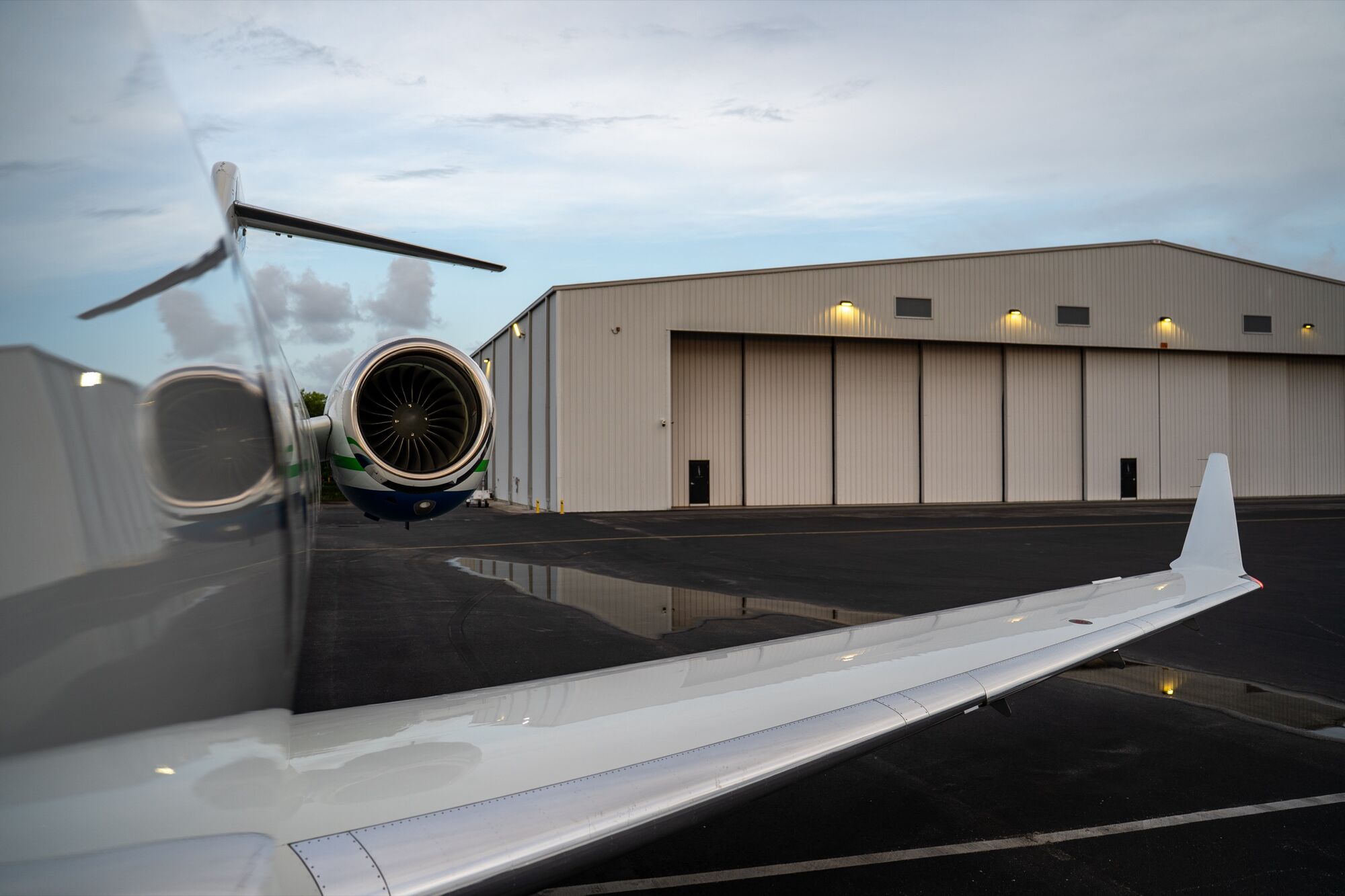
A CRAFT Challenger outside its hangar. The hangar, crew and insurance are paid every year, flown or not.
Variable costs: what each flight hour adds
| Per flight hour | Turboprop | Very light | Light | Midsize | Super-midsize | Large | Ultra-long-range |
|---|---|---|---|---|---|---|---|
| Fuel | $786 | $866 | $1,490 | $1,923 | $2,275 | $2,696 | $3,865 |
| Maintenance | $365 | $400 | $800 | $1,050 | $1,300 | $1,750 | $2,200 |
| Engine reserve | $200 | $400 | $600 | $700 | $825 | $1,000 | $1,300 |
| Fees, crew travel | $225 | $275 | $400 | $525 | $650 | $825 | $1,050 |
| Other | $50 | $70 | $113 | $150 | $188 | $300 | $450 |
| Total (median) | $1,626 | $2,011 | $3,373 | $4,348 | $5,238 | $6,637 | $8,865 |
- Fuel is the biggest hourly cost. The model costs every aircraft's published fuel burn at one price, $7.66 a gallon (October 4, 2026), our estimate of the posted U.S. average at an FBO; contract fuel often costs less. For today's price, see the jet fuel price and each model's fuel burn per hour.
- Maintenance covers scheduled inspections and unscheduled repairs. Owners often enrol the airframe in a maintenance program that turns it into a predictable hourly charge. Pilatus is the only manufacturer that publishes its program rates (CrystalCare: $4,799 a month plus $380 an hour for a PC-12, $17,226 a month plus $820 an hour for a PC-24), and the model uses them for those two; for the rest it carries a stated range by size.
- Engine overhaul is a reserve set aside every hour for the next overhaul, or the hourly fee of an engine program. It is one of the largest single liabilities on a used jet, and a jet sold "on program" is worth more for it. Engine makers quote program rates only on request, so the model carries a stated range per engine by size.
- Fees are landing, parking, handling and crew travel: hotel rooms and meals on the road.
The costs the annual budget leaves out
The annual figures are only the operating budget. Ownership also carries:
- The purchase price. New light jets start in the low millions and ultra-long-range jets pass $75 million. Private jet prices lists new and used prices for 90 models, and UseRadar, our aircraft data site, lists the value and every tail of the Challenger 350, for example, and of most other models.
- Depreciation. Most jets lose value every year, faster when the market softens. How much private jets depreciate has the figures.
- Financing and tax. Interest, sales or use tax at purchase, and the tax treatment of a business aircraft vary by state and use. Take tax advice before buying, not after.
- Refurbishment and upgrades. Interiors, paint, connectivity and avionics upgrades come every several years and can run into the millions on a large jet.
Leasing instead of buying
Leasing lets you fly an aircraft without buying it outright, and the type of lease decides who is responsible for flying it.
| Dry lease | Wet lease | |
|---|---|---|
| What you get | The aircraft only | The aircraft and at least one crew member |
| Who supplies the crew | The lessee | The lessor |
| Who has operational control | The lessee | The lessor, who must hold an air carrier certificate to be paid for it |
| Typical use | Long-term use by a company or family that employs its own crew | Short-term lift from a certificated operator |
The FAA defines a wet lease as "any leasing arrangement whereby a person agrees to provide an entire aircraft and at least one crewmember" (14 CFR 1.1). Paying someone without an air carrier certificate for an aircraft and its crew is the most common form of illegal charter. Wet lease versus dry lease goes through the paperwork, including the truth-in-leasing rules for U.S.-registered aircraft.
When owning makes sense
Ownership tends to pay its way when the aircraft flies a lot: several hundred hours a year, on a schedule only you control, often on the same type of trip. Below about 150 to 200 hours a year, the fixed costs make each hour of ownership more expensive than chartering the same size of jet or buying a jet card, and the capital stays tied up in a depreciating asset.
There are middle paths. A fractional share buys part of an aircraft and a set number of hours. Leaseback puts an owned aircraft on an operator's Part 135 certificate so charter revenue offsets the fixed costs. And a jet card buys hours on a fleet at a fixed hourly rate, with no aircraft to carry; what an hour of charter costs is the number to compare against.
To compare a specific aircraft, open its page from the league table: every model has its line-by-line costs and a budget calculator for the hours you expect to fly.
Frequently asked questions
How much does it cost to own a private jet per year?
Flown 200 hours a year, the median in CRAFT's cost model is about $712,000 for a very light jet, $1.17 million for a light jet, $1.5 million for a midsize jet, $1.82 million for a super-midsize, $2.4 million for a large jet and $3.49 million for an ultra-long-range jet, with a professional crew and fuel at today's posted FBO price. That is before the purchase price, financing and depreciation.
How much does a private jet hangar cost?
Published airport rates put a home-base hangar at about $1,600 to $5,000 a month for a light jet and $5,300 to $17,300 for an ultra-long-range jet (Concord-Padgett and Naples airport rate schedules). CRAFT's cost model uses the middle of each range: about $28,000 a year for a very light jet, $39,000 for a light jet, $66,000 for a super-midsize and $135,000 for an ultra-long-range jet. Space at busy airports near New York, Los Angeles or Miami costs more; small fields cost less.
How much is private jet insurance?
An insurance broker's published 2026 guide puts turboprops at about $8,000 to $18,000 a year and light jets at $15,000 to $30,000. CRAFT's cost model, which prices hull cover on each model's value, carries a median of about $14,000 for a light jet, $39,000 for a large jet and $74,000 for an ultra-long-range jet. The premium depends mostly on the hull value, the pilots' experience and the liability limit.
What is the difference between a wet lease and a dry lease?
A dry lease is the aircraft alone: the lessee supplies the crew and takes operational control. A wet lease is the aircraft with at least one crew member, the FAA's own definition. Paying for a wet lease from anyone who does not hold an air carrier certificate is the classic illegal charter.
How many hours a year make owning a jet worth it?
There is no single number, but the fixed costs decide it. Below about 150 to 200 hours a year, the fixed costs spread over few hours make each hour of ownership cost more than chartering or a jet card for the same size of jet; above about 300 to 400 hours, ownership starts to pay its way, especially with a management company offsetting costs through charter.
Related
Related guides
Aircraft in this guide
Routes and cities
Read next
Statistics
Private Jet Operating Costs, Every Model Ranked
The annual cost to own and operate over 70 private jets and turboprops, ranked: fixed costs, hourly costs and the total at 100, 200 or 400 hours, from one transparent cost model.
October 5, 2026 · 4 min read
Wet lease vs dry lease aircraft: the FAA rules explained
Wet lease vs dry lease for aircraft: FAA definitions, who has operational control, the 14 CFR 91.23 truth-in-leasing rules, why a wet lease without a certificate is an illegal charter, and the legal alternatives.
October 11, 2026 · 6 min read
How Much Do Private Jets Depreciate in Value?
Discover how much private jets depreciate in value over the course of their lifetime, along with the jets that hold their value the best.
January 21, 2026 · 11 min read


Charter Sales
Tell us the trip. We'll tell you the number.
Route, dates, rough timing, how many people. That is enough to start, and you get a firm price for that specific trip rather than a range.
Text us and you'll get a reply within 60 seconds, any hour.