The Craft Blog
Our experiences, shared for your benefit.
Hundreds of articles on what aircraft cost to own and operate, how jet cards and charter compare, and the details that only show up once you fly.
Latest
64 reads
Exchange Funds
How to diversify your portfolio (even if it’s a concentrated one)
· 6 min read
Trending This Week
21k reads
The Basics
The 10 Most Expensive New Private Jets
· 8 min read
- 64 reads
Exchange Funds
How to diversify your portfolio (even if it’s a concentrated one)
Most advice on diversification assumes you’re starting from cash, or from a portfolio that’s already spread across dozens of holdings. Add money to different asset classes, rebalance once a year, and you’re done. That advice works fine until most of your net worth is sitting in one stock, at which p
Sep 18, 2026 · 6 min read
- 84 reads

Exchange Funds
Selling stock and taxes: what you need to know
Let’s say you’re sitting on a position worth $500,000. The cost basis is only $80,000, so you’ve made significant gains. Now let’s say you decide to exit that position. Depending on your state, you could hand somewhere between $100,000 and $155,000 of it straight to federal and state tax collectors
Sep 18, 2026 · 4 min read
- 77 reads
Exchange Funds
How to report RSUs on your tax return
Most people expect their tax return to have a line that says “RSU income: $X.” It doesn’t. If you had restricted stock units vest this year, the return itself won’t ask you a single question about them directly, and this is what can make it tricky. You don’t need to report vested RSUs as a separate
Sep 16, 2026 · 4 min read
- 65 reads

Exchange Funds
What is portfolio diversification?
In 2022, Meta’s stock dropped almost 80% from its high. Employees and long-time shareholders who’d built most of their wealth in company stock watched a huge portion of their portfolio disappear in a matter of months. Meta recovered eventually, but this shows how having too much invested in one stoc
Sep 8, 2026 · 4 min read
- 87 reads

Exchange Funds
How to find the right exchange fund provider for you
A list of exchange funds worth knowing about is actually pretty short. Cache, Goldman Sachs, Morgan Stanley (through its 2021 acquisition of Eaton Vance), and Glidepath are the names that come up again and again once you start researching exchange funds as a way to diversify a concentrated position.
Sep 3, 2026 · 4 min read
- 85 reads
Exchange Funds
RSU tax withholding: what tech employees need to know
RSU tax withholding is where a lot of tech employees get their first unpleasant surprise from equity compensation. Your company withholds taxes the moment your shares vest, but the number on your pay stub and the number you actually owe in April are calculated two different ways. For anyone with a b
Sep 3, 2026 · 4 min read
- 63 reads
Exchange Funds
Why are RSUs taxed so high?
RSUs are taxed high because they’re not taxed as an investment gain when they vest. They’re taxed as ordinary income, the same rate that applies to your salary, at whatever your marginal bracket is that year. For someone already earning a solid base salary, adding six figures of vested stock on top
Sep 3, 2026 · 3 min read
- 59 reads

Exchange Funds
Is an exchange fund the same as an ETF?
An exchange fund and an ETF (exchange-traded fund) are not the same thing, despite the similar names. An ETF is a publicly traded fund anyone can buy on a stock exchange, using cash, with no eligibility requirements. An exchange fund is a private structure limited to accredited investors, who contri
Aug 26, 2026 · 2 min read
- 70 reads

Exchange Funds
Exchange fund vs. selling stock: which is better for you?
Your stock portfolio has grown, and maybe it’s time to start thinking about diversifying or taking some cash out of the market. The two ways people typically do this are by selling stocks or contributing them to an exchange fund. Neither option is better. Which you choose depends on how large the po
Aug 26, 2026 · 3 min read
- 70 reads
Exchange Funds
Should you sell you RSUs immediately?
Every time a batch of RSUs vests, you face the same question: should I sell my RSUs immediately, or hold on to the shares? You already owe ordinary income tax on the full value at vest, whether you sell or not. What happens after that is a separate call, and it’s one you make again […]
Aug 23, 2026 · 4 min read
- 56 reads

Exchange Funds
What is a concentrated stock position?
If a large share of your net worth is tied up in a single company’s stock, you have a concentrated stock position. It’s one of the most common ways investors end up carrying more risk than they realize. There’s a common rule of thumb for what counts as concentrated: a single stock or investment make
Aug 23, 2026 · 3 min read
- 75 reads
Exchange Funds
How to defer capital gains tax on stocks
Selling appreciated stock doesn’t have to mean paying the capital gains tax right away. Several established strategies let you defer that tax, sometimes for years, without giving up the option to sell eventually. The main ways to defer capital gains tax on stock are contributing shares to an exchang
Aug 23, 2026 · 3 min read
- 86 reads
Exchange Funds
What is the exchange fund 7-year holding period?
Every exchange fund comes with a 7-year holding period, IRS-mandated holding period to get the full tax benefit. This seven-year holding period exists because the tax code treats an exchange fund contribution as a genuine exchange, not a sale. A real exchange requires the investor to actually stay i
Aug 23, 2026 · 3 min read
- 76 reads

Exchange Funds
Exchange fund eligibility requirements: do you qualify?
Exchange funds aren’t open to the general public. They’re private investment vehicles, which under SEC rules means participation is legally restricted, not just a matter of minimum account size. Three exchange fund eligibility requirements determine whether you qualify: whether you’re an accredited
Aug 5, 2026 · 3 min read
- 75 reads
Exchange Funds
What happens to RSUs when you leave a company?
Many people treat their RSU grant as a single number, but leaving a job splits it into two completely different pools of stock with two distinct outcomes. Under typical plan terms, unvested RSUs are almost always forfeited the moment you leave a company. Vested RSUs are already yours, and walking ou
Aug 5, 2026 · 4 min read
- 59 reads

Exchange Funds
What is a 721 exchange?
A 721 exchange lets you contribute appreciated property to a partnership in exchange for an ownership interest in that partnership, without triggering a taxable sale. The name comes from Section 721 of the Internal Revenue Code, which governs how property contributed to a partnership is treated for
Aug 2, 2026 · 8 min read
- 74 reads

Exchange Funds
How can you avoid capital gains tax on stocks?
Sell an appreciated stock, and the IRS wants a cut of the gain. That’s the rule, and there’s no way around it once a sale actually happens. You can’t avoid capital gains tax on stocks, so the better question to ask is: How can you reduce or defer what you owe? What triggers capital gains […]
Aug 2, 2026 · 4 min read
- 82 reads
Exchange Funds
Concentrated stock: risks and how to diversify
You have a concentrated stock position if any single stock is worth more than 10% to 20% of your portfolio value. But let’s be real here: It’s not uncommon for people to have an investment portfolio made up of just 1 or 2 stocks. If you have a concentrated stock position, it’s usually because someth
Aug 2, 2026 · 7 min read
- 68 reads
Exchange Funds
How are RSUs taxed? A complete guide to vesting, selling, and diversifying
RSUs get taxed twice, once at vesting and once at sale. The second tax bill is the one people forget is coming. Say you vest 2,000 shares worth $150,000, hold them for 14 months while the stock climbs 40%. When you sell, you trigger capital gains on the 40% increase (on top of the tax […]
Jul 31, 2026 · 5 min read
- 75 reads
Exchange Funds
Exchange funds for concentrated stock positions: What you need to know
If one stock makes up a high percentage of your net worth, you’re holding a concentrated position. Years of vested equity, an early bet that worked out, or a family holding you never sold can quietly turn into the single biggest risk in your portfolio. Your portfolio is exposed to single stock risk.
Jul 31, 2026 · 4 min read
- 100 reads
Exchange Funds
The pros and cons of exchange funds for people with concentrated stock positions
Exchange funds are a fantastic way to diversify your concentrated stock position and defer capital gains tax. You get instant portfolio diversification without having to sell your shares, which means lower risk without a huge tax bill. But, there are some drawbacks like a mutli-year lock-up, accredi
Jul 30, 2026 · 4 min read
- 75 reads
Exchange Funds
The Tax Benefits You Get From Contributing to an Exchange Fund
You’ve had a stock position for years and after some growth, realizing the gains sounds like a good idea. Until you see how much the IRS is going to take. If your shares have grown in value, tax of up to 30% is triggered the moment you sell, and is due in full within the […]
Jul 30, 2026 · 5 min read
- 79 reads
Exchange Funds
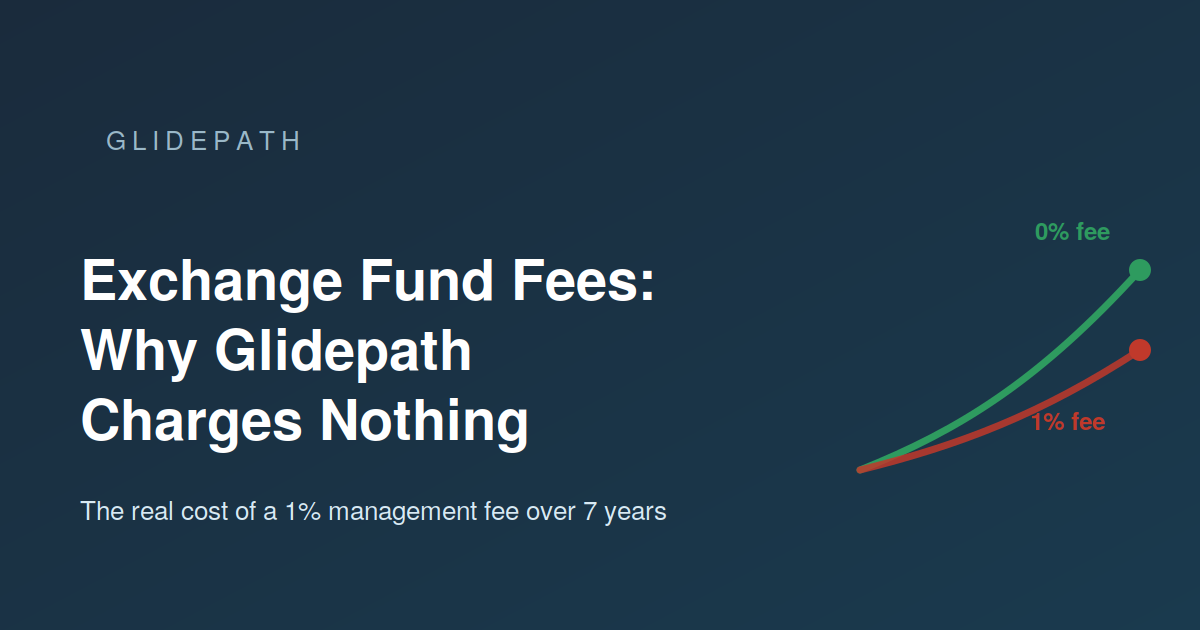
Exchange Fund Fees: Why Glidepath Charges Nothing
Exchange funds let you diversify a concentrated position without triggering a tax bill, so that more of your capital stays invested and compounding. But most exchange funds charge a management fee of around 1% a year, which eats into the very compounding you just protected. In this article, you’ll l
Jul 30, 2026 · 5 min read
- 61 reads
Exchange Funds
What are exchange funds? The complete guide
If you hold a large position in one stock, you’ve probably heard the same piece of advice over the years: diversify. But when you sell to diversify, your company equity that’s vested over years, early bet that paid off, or family holding leads to a large capital gains tax bill. Fear of the IRS shoul
Jul 30, 2026 · 8 min read