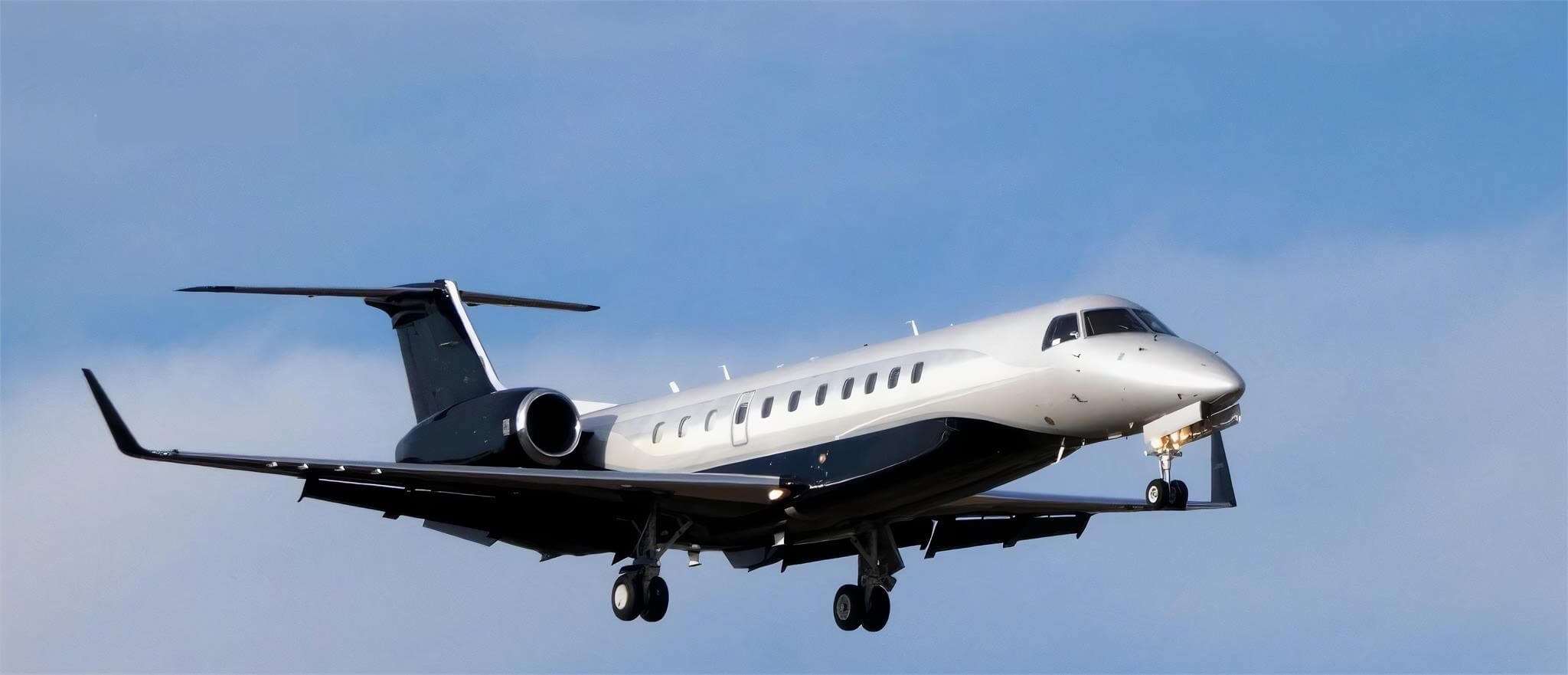
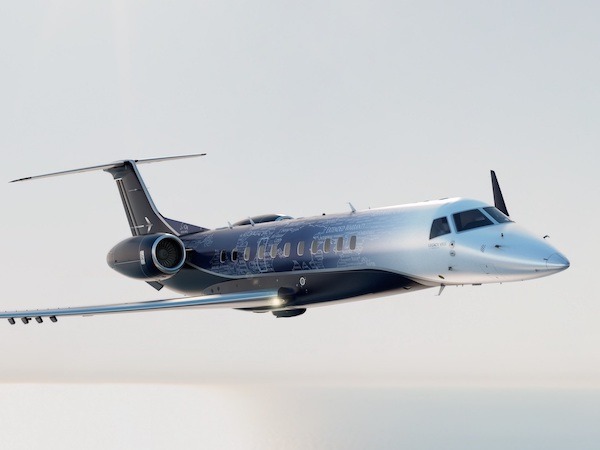
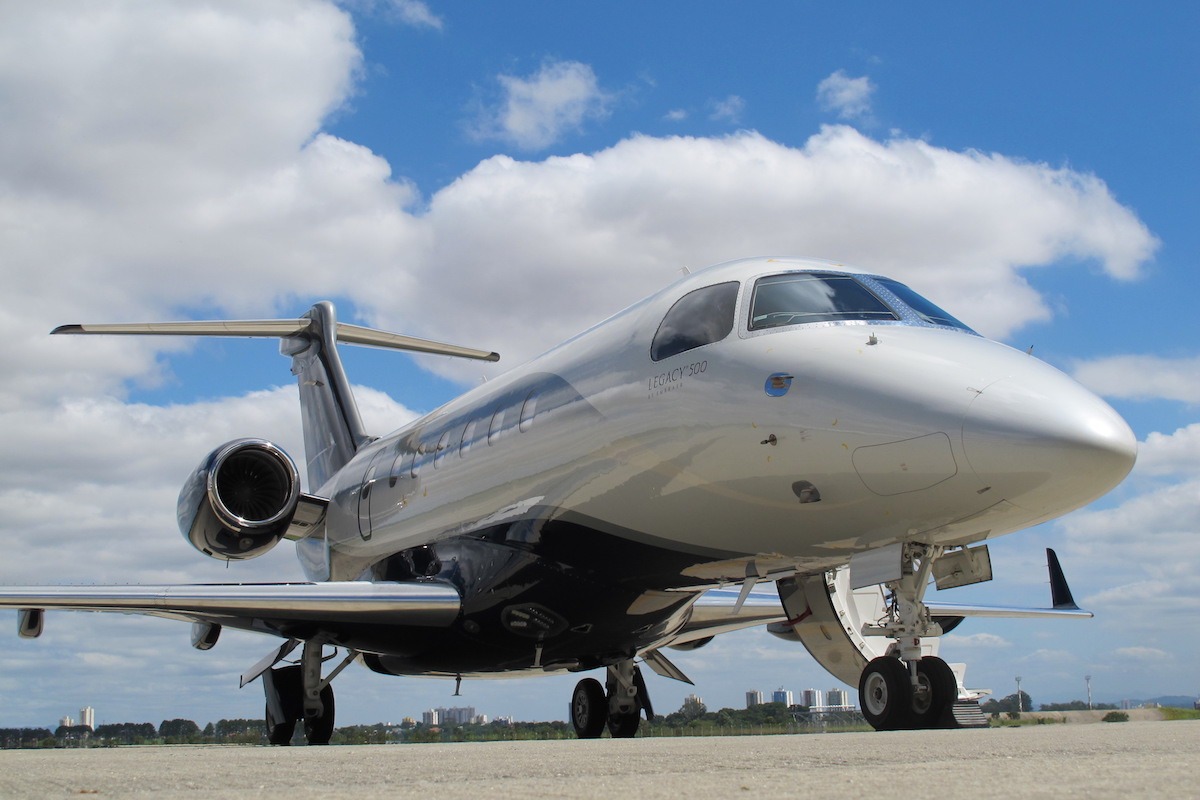
Deliveries of the Embraer Legacy 450 began in 2015, with deliveries ending in 2020. Fifty eight Legacy 450 aircraft are currently in active service.
The Legacy 450 can accommodate up to 9 passengers, with a maximum baggage capacity of 150 cubic feet.
When in its optimum configuration, the Embraer Legacy 450 can cruise non-stop for up to 2,904 nautical miles (3,342 miles / 5,378 km). However, when configured for the fastest cruise speed, the Legacy 450 can maintain a cruise speed of 462 knots.
The Embraer Legacy 450 can cruise at up to 45,000 feet. Additionally, the Legacy 450 has an average hourly fuel burn of 215 Gallons per Hour (GPH).
Thanks to its Honeywell HTF7500E engines, the Legacy 450 has a total thrust output of 13,080 lbs.
In terms of cost, the Legacy 450 has an estimated hourly charter price of $3,800. Furthermore, back when deliveries of the Embraer Legacy 450 began, the list price for a new example was $15.25 million.
Jump straight to the total cost table of the Embraer Legacy 450.
Embraer Legacy 450 Cost Overview
When it comes to operating the Embraer Legacy 450, there are two expense categories to consider – fixed costs and variable costs.
Fixed costs are those that you pay no matter what. Whether the aircraft flies or not has no effect on fixed costs. These costs do not change in relation to the number of hours the aircraft flies.
So, therefore, whether you fly the aircraft 50 hours per year or 500 hours, the fixed costs will remain the same.
The estimated annual fixed cost for operating the Legacy 450 is $500,160.
Variable costs, on the other hand, are directly proportional to the number of hours the aircraft flies per year.
The best example of a variable cost in this case is fuel use. One of the biggest costs when flying by private jet is fuel. See this to learn about private jet fuel costs.
Clearly, the more you fly the aircraft, the more fuel it will use. Therefore, flying 500 hours per year will result in variable costs 10 times greater than if you were to fly 50 hours per year.
Therefore, the estimated variable cost for private jets is presented as an hourly figure. This is how much extra the aircraft will cost you per flight hour.
Therefore, the estimated hourly variable rate for operating the Embraer Legacy 450 is $2,677.
Of course, this hourly variable cost is different to that of the estimated hourly charter price. This is because, per hour, charter flights cost more. There are further parties involved. The hourly charter price is the aircraft’s hourly variable cost, along with factoring in fixed costs and broker fees.
Legacy 450 Fixed Cost Breakdown
When it comes to fixed costs, there are six criteria that have been identified as the biggest contributors to the annual cost of operation.
These costs are crew salary, crew training, hangar, insurance, management and then the additional, miscellaneous fixed costs.
These costs are explained in further detail below the table.
The table below details the estimated cost of each fixed cost for the Embraer Legacy 450.
| Fixed Cost | Annual Spend |
|---|---|
| Crew Salary | $245,985 |
| Crew Training | $52,639 |
| Hangar | $48,988 |
| Insurance | $24,548 |
| Management | $78,000 |
| Miscellaneous Fixed | $50,000 |
| Total | $500,160 |
Crew Salary
The salary of crew members is one of the most significant costs of operating an aircraft.
Naturally, the crew are an essential part to the operation of the aircraft. Without pilots your aircraft will not be going anywhere.
Moreover, crew are essential to the safe operation of your aircraft. Therefore, ensuring that your crew members are appropriately certified and skilled is of paramount important. However, the higher the skill level of the crew, the higher salary they demand.
Crew Training
Having well trained crew members is important. Again, they are integral to the safe and efficient operation of your aircraft.
Keeping aircraft type ratings valid and ensuring that crew members maintain their high standards is key.
This is a cost that will keep on occurring every year, whether your aircraft flies or not.
Hangar Costs
When it comes to aircraft storage there are two options – hangar or tie down.
In most cases, owners are not going to let their multi-million dollar, highly technical machines sit out in the wind and rain. Therefore, it is a safe assumption that most private jets will be stored in hangars when not in use.
However, hangars are more expensive than leaving aircraft out in the elements.
Storage is an important element to consider given that your aircraft will need to be waiting somewhere safe and secure when it isn’t in the air. Sure, there will be some days that the aircraft is away from base and at other airports. However, in most cases aircraft spend the evenings at their home base.
Insurance Costs
In simple terms, there are two types of insurance that private jets must have.
The first is liability insurance. This provides cover against loss, damage or injury to third parties. Third parties in this case include passengers, cargo and baggage. While exact details will vary from policy to policy, cover is generally not provided for the pilot in command or the actual aircraft.
This then leads to the second part of private jet insurance – hull insurance. Hull insurance policies are agreed on a value basis. That is, the value of the aircraft. Therefore, in the event of a total loss, insurers will pay the agreed value as opposed to the current market value.
This are two essential pieces of insurance for private jets. However, owners may also wish to consider aviation hull war insurance and crew insurance.
Aviation hull war insurance provides cover for loss of the aircraft due to war, hijack, confiscation, malicious damage and other similar risks. This is typically chosen by owners who will be flying private jets into hazardous destinations.
Crew insurance allows pilots and crew members to be provided with an enhanced employee benefit package. Such as including loss of licence cover, personal accident cover and travel insurance.
Management Costs
Aircraft management is an essential component when owning and operating a private jet.
An aircraft management team provide all the necessary services required to fly the aircraft. For example, sourcing and managing pilots to making sure the aircraft is airworthy, are all tasks provided by your aircraft management company.
Of course, there is the option of so called self-management. This is where the management tasks are left with your pilot in command. However, this option is rarely selected. Therefore, in the ownership cost example we assume an aircraft management company is involved.
Your aircraft management team will typically perform the following tasks:
- Flight bookings
- Flight planning
- Charter marketing / sales
- Crew scheduling
- Aircraft airworthiness reviews and tasks
- Maintenance scheduling
- Invoice management
- Crew management
Additionally, your aircraft management team will likely provide many more small activities in order to ensure a smooth operation of the aircraft.
Of course, there are many factors that will affect the total price of your aircraft management fee. Primarily the difference in cost will depend on the aircraft type, use and region of operation.
Miscellaneous Fixed Costs
The miscellaneous fixed costs are made up of everything that doesn’t fit into the above categories.
Things such as the fees for charts, software and computers to manage your aircraft will be in this category.
When owning a private jet there will likely be surprise costs and upgrades that occur throughout your ownership experience.
Therefore, it is good practice to factor in additional, unexpected costs per year.