Bombardier / 1988 - 1991
Bombardier Learjet 31
The Bombardier Learjet 31 is a Light jet manufactured by Bombardier between 1988 and 1991.
Explore detailsThe Bombardier Learjet 31 is a favorite in business aviation. It first flew in 1987 and quickly became a top choice. It's known for its speed and altitude.
The Bombardier Learjet 31 has a compact yet useful interior. It focuses on performance over fancy features. The cabin is 268 cubic feet, fitting up to eight passengers and two crew, for a cozy travel experience.
The Bombardier Learjet 31 is known for its top-notch jet performance. It has a maximum speed of Mach 0.81 and can travel 1,877 miles. This makes it great for fast and efficient travel over long distances.
The Bombardier Learjet 31A had advanced avionics and flight systems. These made the aircraft safer and more capable. The Bendix King Electronic Flight Information System 50 was at the center of the cockpit. It gave pi...
The Bombardier Learjet 31 is known for being cost-effective. It's a favorite among light business jets. The yearly fixed costs for the Learjet 31 at 500 flight hours are about $316,617. This includes insurance, hangar fees, and crew training. Variable costs, tied to flight hours, are around $2,181 per hour. These co...
Fleet Registry
Registered Aircraft
Loading registered aircraft...
Value History
Pre-owned market movement based on the stored acquisition timeline.
Range Profile
Compares practical operating range against full-seat and ferry scenarios.
Estimated reduction per added passenger: 16 NM
Hourly Cost Mix
North America hourly ownership cost composition based on stored operating inputs.
Noise Profile
Stored operational noise readings across the main reference conditions.
Key Facts
Operating Costs and Maintenance
The Bombardier Learjet 31 is known for being cost-effective. It's a favorite among light business jets.
The yearly fixed costs for the Learjet 31 at 500 flight hours are about $316,617. This includes insurance, hangar fees, and crew training.
Variable costs, tied to flight hours, are around $2,181 per hour. These costs change based on how much the jet is flown.
Maintenance is key for jet owners, and the Learjet 31 is no different. A 12-year inspection for Learjet 31/35 aircraft costs about $250,000.
Maintenance for the Learjet 30 series costs between $1,700 to $2,000 per flight hour.
This includes the Maintenance Service Plan (MSP) for both engines and calendar time inspections.
The cost for a 12-year inspection on Learjet 31/35 aircraft can vary from $125,000 to $180,000. Total maintenance costs, including all expenses, are about $1,800 to $2,000 per flight hour.
This is with an estimated annual usage of 350-400 hours.
It's important to manage maintenance, repair, and overhaul expenses well. This helps avoid selling an aircraft due to high maintenance costs.
The costs of owning an aircraft include direct expenses like crew salaries, insurance, and hangar fees. These need to be managed to keep the aircraft running smoothly in the long term.
Purchase Considerations
The Learjet 31 is affordable and performs well, making it a great choice for buyers. It has a Vref Price Range of $543,000 - $689,000.
Its Variable Cost per Hour is $3,102, balancing cost and performance.
Range Map
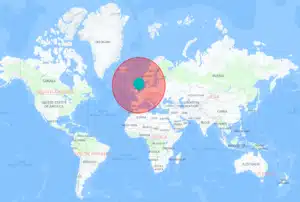
Introduction to the Bombardier Learjet 31
The Bombardier Learjet 31 is a favorite in business aviation. It first flew in 1987 and quickly became a top choice.
It's known for its speed and altitude.
Brief History and Development
The Learjet 31 was made to improve on the Learjet 29. It combined the best parts of earlier Learjets.
Bombardier's skill showed in its design, making it a leader in its class.
Production Timeline (1988-1991)
- Bombardier made 262 Lear 31 aircraft from 1988 to 2002.
- 38 of these were the "straight" 31 models with old avionics and a special windshield de-icer.
- The Learjet 31A, launched in 1991, was the main model made.
Market Impact and Legacy
The Learjet 31 made a big impact, even though it was made for only a few years. Its great performance and lasting popularity make it an icon.
It still inspires new business jets today.
"The Learjet 31 set the bar high for speed and altitude capabilities in its class, paving the way for future innovations in the business aviation industry."
Design Features and Innovations
The Bombardier Learjet 31 is a standout corporate jet with a unique design. It combines the fuselage and engines of the Learjet 35/36 with the "Longhorn" wing from the 28, 29, and 55 models.
This combination gives the Learjet 31 impressive performance.
One of its key features is the innovative delta fins at the bottom of the empennage. These fins greatly improve the aircraft's stall characteristics and directional stability.
The Learjet 31 can cruise at altitudes between 41,000 and 47,000 feet. This shows its ability to fly high.
Its design not only boosts its aviation technology but also its corporate jet performance. It's a top choice in the aircraft design world.
| Design Feature | Benefit |
|---|---|
| Fuselage and engines from Learjet 35/36 | Proven reliability and performance |
| "Longhorn" wing from Learjet 28, 29, and 55 | Improved aerodynamics and efficiency |
| Delta fins at the bottom of the empennage | Enhanced stall characteristics and directional stability |
| High-altitude cruise capability | Impressive performance and fuel efficiency |
Performance Specifications and Capabilities
The Bombardier Learjet 31 is known for its top-notch jet performance. It has a maximum speed of Mach 0.81 and can travel 1,877 miles.
This makes it great for fast and efficient travel over long distances.
Speed and Range Characteristics
The Learjet 31 flies at 441 knots, making it one of the fastest business jets. It can travel 1,877 miles without needing to refuel.
This means passengers can reach their destinations quickly and without stops.
Altitude and Climbing Abilities
The Learjet 31 can fly up to 51,000 feet, a rare feat for a civil aircraft. It can climb to 5,480 feet per minute.
This makes getting to cruising altitude fast and efficient.
Fuel Efficiency Metrics
Fuel efficiency is key for any jet, and the Learjet 31 excels here. It uses about 177 gallons of fuel per hour.
This makes it a budget-friendly choice for both business and private flying.
| Specification | Value |
|---|---|
| Maximum Speed | Mach 0.81 |
| Range | 1,877 miles |
| Service Ceiling | 51,000 feet |
| Rate of Climb | 5,480 ft/min |
| Fuel Consumption | 177 gallons/hour |
The Learjet 31 stands out in the business aviation market. Its performance, range, and fuel efficiency make it a top choice.
Learjet 31 Engine Technology
The Bombardier Learjet 31 is a twin-engined business jet made from 1988 to 2002. It has two Honeywell TFE731 turbofan engines.
These engines are known for their top-notch performance and dependability, making the Learjet 31 a favorite among private and corporate flyers.
The first Learjet 31 models came with TFE731-2 engines, each giving 3,500 pounds of thrust. Later, the engines were upgraded to the TFE731-2C, boosting the aircraft's abilities even more.
The Learjet 31A, launched in 1991, had a new engine control system - the N1 Digital Electronic Engine Control (DEEC). This new tech replaced the old N2 DEEC, leading to better engine performance and fuel use.
- Learjet 31 powered by Honeywell TFE731 turbofan aircraft engines
- Early models equipped with TFE731-2 engines (3,500 lbs thrust)
- Later versions upgraded to more powerful TFE731-2C engines
- Learjet 31A introduced N1 Digital Electronic Engine Control (DEEC) system
The turbofan technology in the Learjet 31's jet propulsion system is key. It helps the aircraft reach high speeds, cover long distances, and use fuel efficiently.
This advanced engine design has made the Learjet 31 a long-time favorite in the market.
Cabin Configuration and Comfort
The Bombardier Learjet 31 has a compact yet useful interior. It focuses on performance over fancy features.
The cabin is 268 cubic feet, fitting up to eight passengers and two crew, for a cozy travel experience.
Passenger Capacity and Layout
The Learjet 31's cabin is simple but efficient. It doesn't have a galley or advanced toilet, but seats 4 to 5 people.
This setup makes the most of the space, ensuring a comfortable trip.
Interior Dimensions and Storage
The Learjet 31's cabin is cozy but functional. It's 4 feet, 4 inches tall and 12 feet, 11 inches long.
It also has 30 cubic feet for luggage, perfect for short to medium flights.
Though it's not as luxurious as bigger jets, the Learjet 31 focuses on cabin comfort and private jet interior. It meets the needs of those who value efficiency and cost in luxury travel.
Advanced Avionics and Flight Systems
The Bombardier Learjet 31A had advanced avionics and flight systems. These made the aircraft safer and more capable.
The Bendix King Electronic Flight Information System 50 was at the center of the cockpit. It gave pilots all the flight data they needed.
The Universal 1M, 1B, and 1C flight management system was also part of the Learjet 31A. It helped with precise navigation and planning.
The KFC 3100 autopilot system, with its pitch, roll, and yaw dampers, and flight director, improved control.
Pilots could use dual Bendix King VCS-40A communication units and VN-411B Series III navigation receivers. These ensured reliable communication and navigation.
The aircraft avionics, flight management systems, and cockpit technology of the Learjet 31A raised the bar for light business jets. It brought more safety, efficiency, and awareness to the cockpit.
| Avionics Feature | Description |
|---|---|
| Bendix King EFIS 50 | Electronic Flight Information System providing comprehensive flight data |
| Universal 1M, 1B, 1C | Advanced flight management system for navigation and flight planning |
| KFC 3100 Autopilot | Autopilot with pitch, roll, and yaw dampers, and flight director |
| Bendix King VCS-40A | Dual communication units for reliable in-flight communication |
| Bendix King VN-411B | Series III navigation receivers for precise navigation capabilities |
Safety Features and Certifications
The Bombardier Learjet 31 stands out for its safety thanks to its design. Its delta fins greatly improved its stability and removed the need for a complex stall avoidance device.
This made the certification process easier and boosted aircraft safety and pilot confidence.
The Learjet 31 also meets strict aviation regulations and safety standards for business jets. Its emergency systems are tested and certified to ensure top flight safety for everyone on board.
Delta Fins Innovation
The Learjet 31's delta fins were key in enhancing its stability. They replaced the need for a traditional "stick pusher" system.
This design improved the aircraft's safety without adding complexity, making it easier to certify.
Emergency Systems
- The Learjet 31 has standard emergency systems and safety features, following aviation regulations for aircraft safety.
- These include emergency exits, fire extinguishers, and backup power for critical systems in emergencies.
- Details on the specific emergency systems are not shared publicly, as manufacturers keep this information confidential.
Model Variants and Improvements
The Bombardier Learjet 31 has seen many upgrades over the years. These changes show the company's dedication to innovation and customer happiness.
The Learjet 31 now performs better, has advanced avionics, and is more versatile, making it a top choice for business jets.
Learjet 31A Enhancements
In October 1990, Bombardier launched the Learjet 31A. It had faster cruising speed, a new digital avionics system, and an updated control panel.
These changes made flying easier and safer for pilots. The Learjet 31A also had more weight for takeoff and landing, making it even more useful.
Learjet 31ER Features
In 2000, Bombardier introduced the Learjet 31ER. It could fly 1,911 nautical miles (3,539 km) non-stop.
This made it great for longer trips, meeting the needs of business and private flyers. The Learjet 31ER also had better brakes, thanks to standard thrust reversers.
These upgrades show Bombardier's ongoing effort to make the Learjet 31 better. They've added the latest aviation technology advancements to meet the changing needs of aircraft users.
The Learjet 31's ability to adapt and innovate has made it a lasting success in the aviation world.
Market Position and Competition
The Bombardier Learjet 31 was known for its speed and high altitude. But, its small cabin and shorter range limited its production.
It competed with Cessna and Hawker, but its unique features made it stand out.
Learjet has made over 3,000 aircraft since 1962, with 2,000 still flying. The Learjet 31 was introduced in 1987 and stopped production in 2003.
It had a small cabin, measuring 1.5 meters tall and 1.55 meters wide.
Big private jets like Bombardier's Global series have taller and wider cabins. Gulfstream's G650 and Dassault's Falcon 6X are even bigger.
This size difference made the Learjet 31 less appealing to some buyers.
Despite its size, the Learjet 31 was known for its performance. But, its high price made it harder to sell.
Today, it faces tough competition from newer, bigger jets that meet more modern needs.
Notable Operators and Usage
The Bombardier Learjet 31 has been used by many. This includes private jet operators, corporate aviation, and government agencies.
It was popular from 1987 to 2003 because of its speed and range.
NASA used the Learjet 31 for science and research. The United Arab Emirates government bought several for their leaders.
Vinci Aviation in Canada used them for corporate charters.
EN Securities in Iran used the Learjet 31 for trading stocks. They liked its ability to fly high and stay stable.
| Operator | Usage |
|---|---|
| NASA | Scientific and research applications |
| United Arab Emirates Government | Executive transport |
| Vinci Aviation (Canada) | Private charter services |
| EN Securities (Iran) | Airborne securities trading |
The Learjet 31 was loved by many. It was great for different jobs, showing it could do a lot.
Investment Value and Current Market Status
The Bombardier Learjet 31 is a popular choice for those looking to invest in used private jets. When new, it cost $4.5 million.
Now, you can find a used Learjet 31 for about $500,000, depending on its condition and hours flown.
In the late 1990s to early 2000s, a Learjet 31A was worth around $600,000, as of 2018.
Resale Value Analysis
The Learjet 31 holds its value well, which is a big plus for investors. It has a stable resale market compared to other used private jets.
This stability makes the Learjet 31 a smart investment in the aircraft investment and used private jets market.
| Model | Vref Price Range | Variable Cost per Hour | Normal Cruise Speed | Total Baggage Volume | Average Fuel Burn | NBAA IFR Range-Seats Full | Payload with Fuel Full |
|---|---|---|---|---|---|---|---|
| Learjet 31 | $543,000 - $689,000 | $3,102 | 441 KTAS | 30 cu. ft. | 195 gallons per hour | 1,211 NM | 243 lbs. |
The Learjet 31 is a solid investment due to its affordability, performance, and resale value. It's a top pick in the aviation market trends for those wanting a reliable and capable used private jet.
Technical Specifications and Dimensions
The Bombardier Learjet 31 is a top mid-sized business jet. It's known for its advanced aviation engineering and performance.
It has a total length of 48 feet 8 inches, a wingspan of 43 feet 10 inches, and a height of 12 feet 3 inches.
Its wing area is 264.5 square feet. The Learjet 31 has an empty weight of 9,857 lbs and a gross weight of 15,500 lbs.
It also has a fuel capacity of 4,124 lbs and a maximum payload of 1,397 lbs.
| Specification | Measurement |
|---|---|
| Length | 48 feet 8 inches |
| Wingspan | 43 feet 10 inches |
| Height | 12 feet 3 inches |
| Wing Area | 264.5 square feet |
| Empty Weight | 9,857 lbs |
| Gross Weight | 15,500 lbs |
| Fuel Capacity | 4,124 lbs |
| Maximum Payload | 1,397 lbs |
These specs and dimensions highlight the Learjet 31's impressive engineering. It's a top choice in aviation.
Regulatory Compliance and Documentation
The Bombardier Learjet 31 and its variants meet strict aviation rules from the Federal Aviation Administration (FAA). The Type Certificate Data Sheet (TCDS) outlines its certification, operational limits, and airworthiness needs.
Operators of the Learjet 31 must follow strict maintenance and documentation rules. This ensures they stay in line with FAA regulations.
They must use the aircraft's Maintenance Manual, Illustrated Parts Catalog, and Structural Repair Manual. They also need to follow any Airworthiness Directives (ADs) from the FAA.
- Estimated cost of compliance with ADs for Bombardier Learjet airplanes affected is approximately $19,904,258 for U.S. operators.
- The AD affects an estimated total of 706 airplanes registered in the U.S.
- Labor cost for the replacement of the flap nose roller fitting, nose roller support bracket, and adjacent rib support structure with improved components is estimated at 188 work-hours × $85 per hour, totaling $15,980 per product.
- Parts costs for replacement kits range from $780 to $1,912, with different kit numbers identified for various airplane models.
- Compliance with the AD must be accomplished within 24 months after the effective date or within 400 landings, whichever comes first, for certain Learjet airplane models.
The Learjet 31 also has specific flight documentation needs. This includes the FAA-approved Flight Manual.
It details the aircraft's performance, operating limits, and emergency steps. Operators must keep all flight documents current and easily accessible.
"The AD is issued under title 49 of the United States Code, section 106, and Subtitle VII, Part A, Subpart III, Section 44701, as part of aviation safety regulations under the FAA's authority."
By following these rules and keeping detailed records, Learjet 31 operators can keep their aircraft safe and compliant. This ensures they meet the latest aviation regulations, aircraft certification, and flight documentation standards.
Conclusion
The Bombardier Learjet 31 is a key part of the Learjet legacy and the business aviation world. It was a leader in performance and altitude in its time.
This makes it a standout in private jet history.
Even though it's not made anymore, the Learjet 31 still flies around the world. Its design and features are still loved by many.
It shows how well-made and lasting this aircraft is.
The Learjet 31's fame shows it's still loved today, especially in Europe. It's known for its speed, ease of flying, and luxury.
It meets the needs of today's business travelers, both in Europe and beyond.
What is the Bombardier Learjet 31?
The Bombardier Learjet 31 is a fast business jet made from 1988 to 1991. It's a cost-effective choice for short trips, carrying eight people and two crew.
What are the key features of the Learjet 31?
The Learjet 31 has a special design. It combines the Learjet 35/36's body and engines with the "Longhorn" wing.
It also has delta fins at the bottom for better stability.
What are the performance specifications of the Learjet 31?
The Learjet 31 can fly up to Mach 0.81 and go 1,877 miles. It can reach 51,000 feet and climb quickly.
It uses about 177 gallons of fuel per hour.
What engines power the Learjet 31?
The Learjet 31 uses two Garrett TFE731-2 turbofan engines. Each engine has 3,500 pounds of thrust.
Later models got even more powerful engines.
How many Learjet 31 models were produced?
Only 38 original Learjet 31 models were made. Then, the 31A and 31ER were introduced.
What are the notable improvements in the Learjet 31A and 31ER variants?
The Learjet 31A came out in 1990 with a faster speed and digital avionics. The 31ER has a longer range of 1,911 nautical miles.
How much does it cost to operate a Learjet 31?
Running the Learjet 31 for 500 hours costs about $316,617 a year. Hourly costs are around $2,181.
What is the current market status and resale value of the Learjet 31?
New Learjet 31s were $4.5 million. Now, used ones cost about $500,000.
Learjet 31As from the late 1990s to early 2000s were worth around $600,000 in 2018.
Source Links
- https://aircraftexchange.com/blog/our-guide-to-the-bombardier-learjet-31
- https://en.wikipedia.org/wiki/Learjet_31
- https://www.bjtonline.com/business-jet-news/learjet-31a
- https://airly.com/end-of-an-era-vale-the-learjet-long-live-the-business-jet/
- https://centurionjets.aero/aircraft/bombardier-learjet-31/
- https://www.jetfinder.com/our-fleet/bombardier-learjet-31/
- https://aviationweek.com/business-aviation/learjet-31a-sporty-performance-compact-interior-short-range
- https://procharter.com/aircraft/aircraft-guide/passenger-aircraft-guide/bombardier-learjet-31/
- https://www.businessairnews.com/hb_aircraftpage.html?recnum=LR31
- https://aeroaffaires.com/private-jet-hire/light-jets/learjet-31/
- https://www.airliners.net/forum/viewtopic.php?t=579415
- https://www.jetfinder.com/our-fleet/bombardier-learjet-75/
- https://jettly.com/private_jet/learjet-31a
- https://centurionjets.aero/aircraft/bombardier-learjet-31a/
- https://www.aircharterservice.com/aircraft-guide/private/bombardier-canada/bombardierlearjet31
- https://www.stratosjets.com/private-jets/lear-31/
- https://www.aopa.org/news-and-media/all-news/2014/july/pilot/t_ql
- https://www.beechtalk.com/forums/viewtopic.php?f=49&t=125054
- https://propilotmag.com/operating-costs/
- https://simpleflying.com/learjet-family-variants-guide/
- https://simpleflying.com/learjet-private-jet-competitive-2023/
- https://www.linkedin.com/pulse/jet-aircraft-massive-market-opportunity-opening-up-boeing-yeotikar-p5nff?trk=article-ssr-frontend-pulse_more-articles_related-content-card
- https://www.mightytravels.com/2024/10/end-of-an-era-prima-air-group-retires-last-learjet-31a-marking-shift-in-private-aviation-landscape/
- https://www.apertus.aero/news/2022412/learjet-a-legacy-to-be-remembered
- https://www.duncanaviation.aero/files/aircraft-sales/Business-Jet-Model-Market-Summary-Metric.pdf
- https://www.duncanaviation.aero/files/aircraft-sales/Business-Jet-Model-Market-Summary.pdf
- https://jetav.com/bombardier-learjet-31a-specs-and-description/
- https://www.aerospace-technology.com/projects/learjet_31a/
- https://www.federalregister.gov/documents/2018/09/18/2018-19853/airworthiness-directives-learjet-inc-airplanes
- https://www.govinfo.gov/content/pkg/FR-2007-08-28/pdf/E7-16676.pdf
- https://downloads.regulations.gov/FAA-2018-0327-0004/attachment_2.pdf
- https://www.flyoke.com/bombardier-learjet-31-review/
- https://private-jet.aero/catalog/very-light-jets/learjet-31/
- https://www.jetnet.com/resources/press-releases/history-of-learjet/
Private Aviation Advisory